
Three Early Structural Decisions That Shape Carbon, Cost, and Coordination
Early structural decisions often happen before any calculations are performed – sometimes even before a structural engineer is formally brought into the project. Yet these early moves quietly determine far more of the building’s final outcome than most people realize.
These choices set the tone for how the building performs, how efficiently it is coordinated, how smoothly the project goes, and even how cost-effective and low-carbon the structure can be.
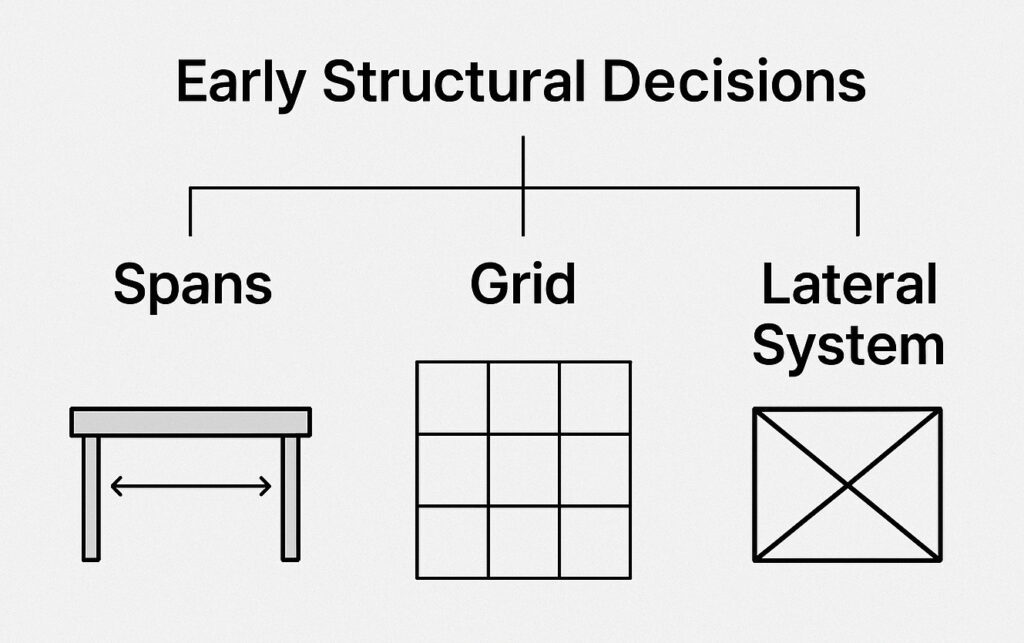
While there are always dozens of factors in play on any project, three early decisions consistently have the biggest downstream impact: spans, grid alignment, and lateral strategy. Getting these right early doesn’t eliminate challenges, but it dramatically reduces friction for the entire team.
1. Span Lengths: The Quiet Driver of Material and Cost
Span length is one of the earliest – and most consequential – design decisions. Longer spans often create cleaner architectural floor plans and provide flexibility for future use. But they also:
- increase structural depth
- add material quantities
- heighten vibration sensitivity
- place more pressure on floor-to-floor heights
- affect facade alignment and module planning
Shorter spans, on the other hand, typically improve stiffness, reduce material, simplify vibration control, and make MEP routing easier.
There’s no “right” answer. The key is understanding, early on, what the project values most – long-term flexibility, material efficiency, speed, vibration control, or architectural clarity.
A well-chosen span strategy avoids surprises later, when changing the structural depth or vibration behavior is far more difficult.
2. Grid Alignment and Regularity: How the Building Organizes Itself
A thoughtful grid is one of the most reliable ways to make a project smoother for every discipline. A regular, well-aligned grid:
- reduces the need for transfer beams
- creates predictable load paths
- simplifies MEP planning
- aligns with façade modules
- lowers coordination time
- supports more predictable cost and schedule outcomes
Irregular grids aren’t a problem in themselves – architecture often calls for them. The challenge is that irregularity introduces structural discontinuities, transfers, complex detailing, and coordination effort that must be managed intentionally.
Early clarity on the grid is one of the most effective ways to reduce design friction and avoid unnecessary structural gymnastics later on.
3. Lateral System Strategy: How the Building Resists Wind and Seismic Forces
Before anyone decides whether the structure will be steel, concrete, or mass timber, the team must answer a fundamental question: Where does the building want to resist wind and seismic loads?
Lateral strategy is less about choosing between shear walls, braced frames, or moment frames, and more about placing stability elements in locations that help the architecture rather than conflict with it.
An early lateral strategy influences:
- planning flexibility (especially around stairs, cores, and egress)
- how cleanly loads travel to foundations
- façade detailing where stiff elements meet more flexible edges
- column-free areas the architecture may want to preserve
- how clearly the building “reads” structurally
A well-placed core or brace line can dramatically simplify the building. A poorly placed one can complicate nearly everything that follows.
This is one of the quietest – and most important – decisions in the early design phase.
Why These Early Decisions Matter
What ties these three decisions together is not the structural system or material choice. It’s the ripple effect they have across the entire team:
- architecture
- MEP planning
- contractor sequencing
- façade design
- cost estimating
- code compliance
- sustainability and carbon performance
Better early decisions lead to cleaner drawings, fewer surprises, fewer transfer structures, lower carbon, and a more predictable process for everyone involved.
Final Thoughts
Structural engineering doesn’t begin when the calculations start — it begins when the earliest design conversations happen. Spans, grids, and lateral strategy shape the project long before materials are chosen or details are drawn.
Bringing structural thinking into schematic design early isn’t about locking anything in — it’s about creating clarity, reducing downstream friction, and giving the entire team a smoother path forward.
This is where structural engineers can add some of the most meaningful value to a project, often before anyone realizes it’s happening.
For more on embodied carbon, see the SE 2050 Resource Hub: https://se2050.org/resources/
To learn more about our approach, visit our Services page: https://corastructural.com/services