Posts By :

Michael Gryniuk

Three Early Structural Decisions That Shape Carbon, Cost, and Coordination 150 150 CORA Structural

Three Early Structural Decisions That Shape Carbon, Cost, and Coordination

Early structural decisions often happen before any calculations are performed – sometimes even before a structural engineer is formally brought into the project. Yet these early moves quietly determine far more of the building’s final outcome than most people realize.

These choices set the tone for how the building performs, how efficiently it is coordinated, how smoothly the project goes, and even how cost-effective and low-carbon the structure can be.

While there are always dozens of factors in play on any project, three early decisions consistently have the biggest downstream impact: spans, grid alignment, and lateral strategy. Getting these right early doesn’t eliminate challenges, but it dramatically reduces friction for the entire team.
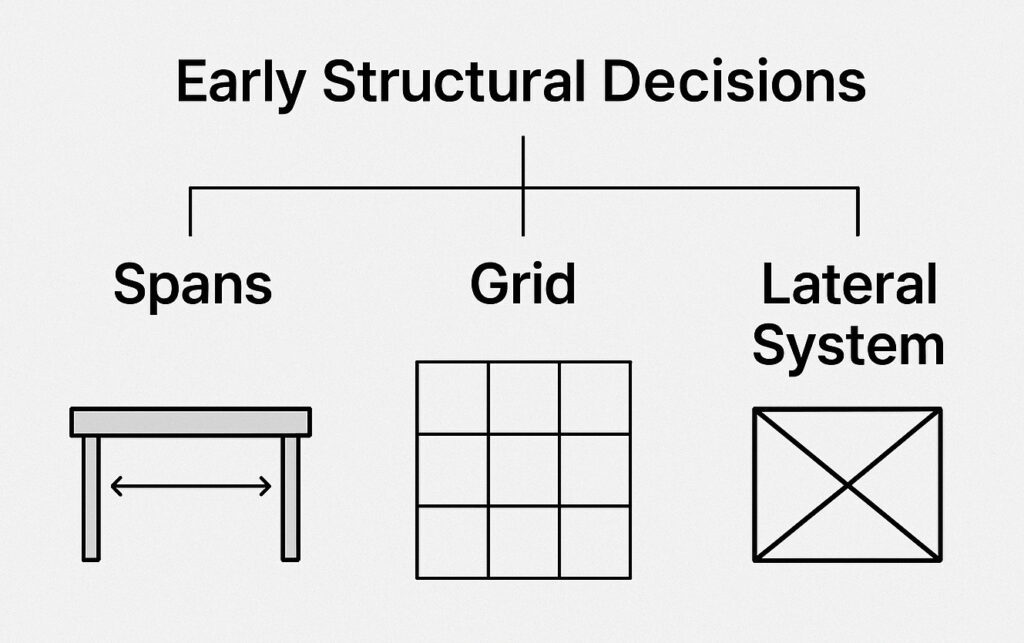
A simple overview of the three early structural decisions – spans, grids, and lateral systems – that quietly shape carbon, cost, and coordination.

1. Span Lengths: The Quiet Driver of Material and Cost

Span length is one of the earliest – and most consequential – design decisions. Longer spans often create cleaner architectural floor plans and provide flexibility for future use. But they also:

  • increase structural depth
  • add material quantities
  • heighten vibration sensitivity
  • place more pressure on floor-to-floor heights
  • affect facade alignment and module planning

Shorter spans, on the other hand, typically improve stiffness, reduce material, simplify vibration control, and make MEP routing easier.

There’s no “right” answer. The key is understanding, early on, what the project values most – long-term flexibility, material efficiency, speed, vibration control, or architectural clarity.

A well-chosen span strategy avoids surprises later, when changing the structural depth or vibration behavior is far more difficult.


2. Grid Alignment and Regularity: How the Building Organizes Itself

A thoughtful grid is one of the most reliable ways to make a project smoother for every discipline. A regular, well-aligned grid:

  • reduces the need for transfer beams
  • creates predictable load paths
  • simplifies MEP planning
  • aligns with façade modules
  • lowers coordination time
  • supports more predictable cost and schedule outcomes

Irregular grids aren’t a problem in themselves – architecture often calls for them. The challenge is that irregularity introduces structural discontinuities, transfers, complex detailing, and coordination effort that must be managed intentionally.

Early clarity on the grid is one of the most effective ways to reduce design friction and avoid unnecessary structural gymnastics later on.


3. Lateral System Strategy: How the Building Resists Wind and Seismic Forces

Before anyone decides whether the structure will be steel, concrete, or mass timber, the team must answer a fundamental question: Where does the building want to resist wind and seismic loads?

Lateral strategy is less about choosing between shear walls, braced frames, or moment frames, and more about placing stability elements in locations that help the architecture rather than conflict with it.

An early lateral strategy influences:

  • planning flexibility (especially around stairs, cores, and egress)
  • how cleanly loads travel to foundations
  • façade detailing where stiff elements meet more flexible edges
  • column-free areas the architecture may want to preserve
  • how clearly the building “reads” structurally

A well-placed core or brace line can dramatically simplify the building. A poorly placed one can complicate nearly everything that follows.

This is one of the quietest – and most important – decisions in the early design phase.


Why These Early Decisions Matter

What ties these three decisions together is not the structural system or material choice. It’s the ripple effect they have across the entire team:

  • architecture
  • MEP planning
  • contractor sequencing
  • façade design
  • cost estimating
  • code compliance
  • sustainability and carbon performance

Better early decisions lead to cleaner drawings, fewer surprises, fewer transfer structures, lower carbon, and a more predictable process for everyone involved.


Final Thoughts

Structural engineering doesn’t begin when the calculations start — it begins when the earliest design conversations happen. Spans, grids, and lateral strategy shape the project long before materials are chosen or details are drawn.

Bringing structural thinking into schematic design early isn’t about locking anything in — it’s about creating clarity, reducing downstream friction, and giving the entire team a smoother path forward.

This is where structural engineers can add some of the most meaningful value to a project, often before anyone realizes it’s happening.

For more on embodied carbon, see the SE 2050 Resource Hub: https://se2050.org/resources/

To learn more about our approach, visit our Services page: https://corastructural.com/services
H.764 – An Act incorporating embodied carbon into state climate policy 768 1024 CORA Structural
H.764 - An Act incorporating embodied carbon into state climate policy

H.764 – An Act incorporating embodied carbon into state climate policy

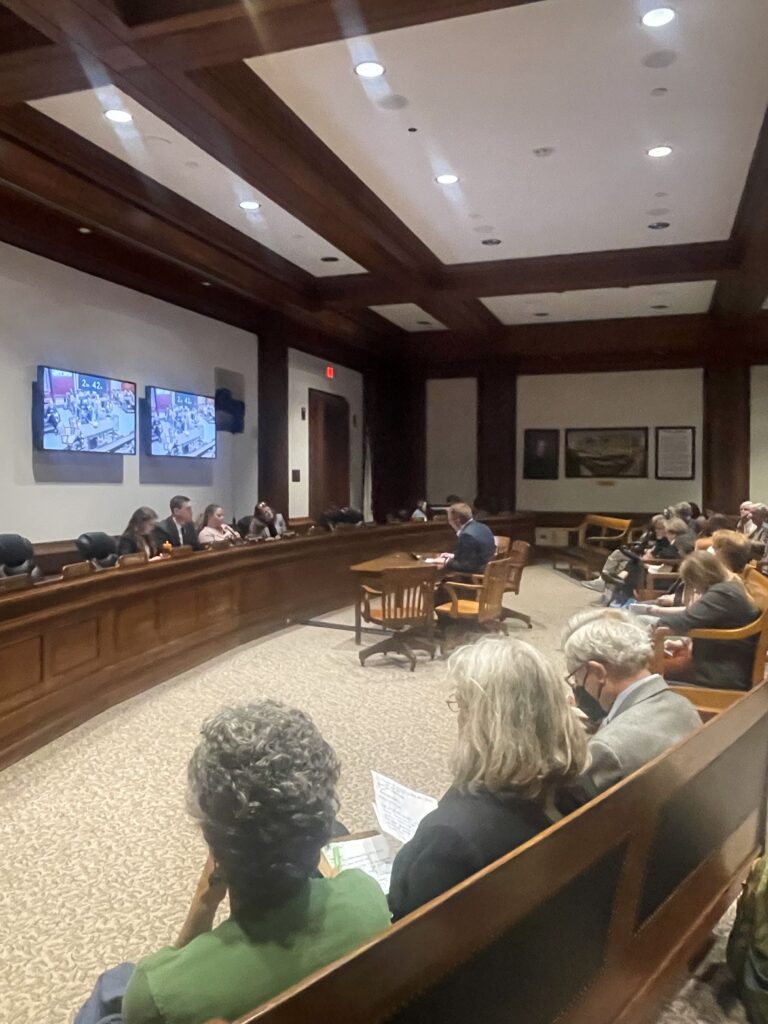
One of the critical bills that addresses embodied carbon in the state, H.764 An Act incorporating embodied carbon into state climate policy, had a hearing in front of the Joint Committee on Environment and Natural Resources on May 17. As summarized on the Massachusetts Climate Action Network’s (MCAN) website, this legislation proposes the following:

  • Establishes a state advisory board to address embodied carbon
  • Requires the Department of Energy Resources to put forward recommendations and best practices for measuring and reducing embodied carbon
  • Requires a report outlining effective regulation strategies for reducing embodied carbon
  • Requires the measurement and reduction of embodied carbon to be incorporated into the stretch and specialized stretch energy code

Several members of the local AEC community provided verbal testimony on behalf of H.764. Participants were given three minutes (which they most definitely held everyone to!) to complete testimony with additional time given to respond to any questions members of the committee might have. Michael Gryniuk, as a local practicing structural engineer and current chair of SE 2050, spent the majority of his allotted time highlighting the embodied carbon associated with conventional structural materials and structural embodied carbon ‘wins’ in the Commonwealth.

We have the technology to make substantive embodied carbon reductions in our structural systems today, right now, without significant impacts to schedule and cost, if done thoughtfully, deliberately, and introduced during the early design phases

Michael Gryniuk, Founder and Principal

The testimony for H.764 took place after testimony for several other bills, which in of itself, was interesting to observe. H.764 had a strong showing with several local practitioners and educators also offering testimony, both in person and through the remote option. We will continue to see how this legislation moves through the committee and work on collectively advocating and educating the legislatures. We’ve already connecting with a few of the legislatures and looking forward to trying to make this bill a reality.

Other legislation making its way through the legislation, and listed on MCAN’s website, are:

  • H.764/S.2090 An Act Incorporating Embodied Carbon into State Climate Policy
    • Sponsors: Rep. Ciccolo & Rep. Owens, Sen Comerford
  • H.3035/S.1981 An Act requiring state procurement of low-carbon building materials
    • Sponsors: Rep. Garballey, Sen Creem
  • S.1982/H.3002 An Act relative to the use of low-embodied carbon concrete in state projects
    • Sponsors: Rep. Cahill, Sen. Creem
Structures Congress 2023 Wrap-Up 1024 768 CORA Structural
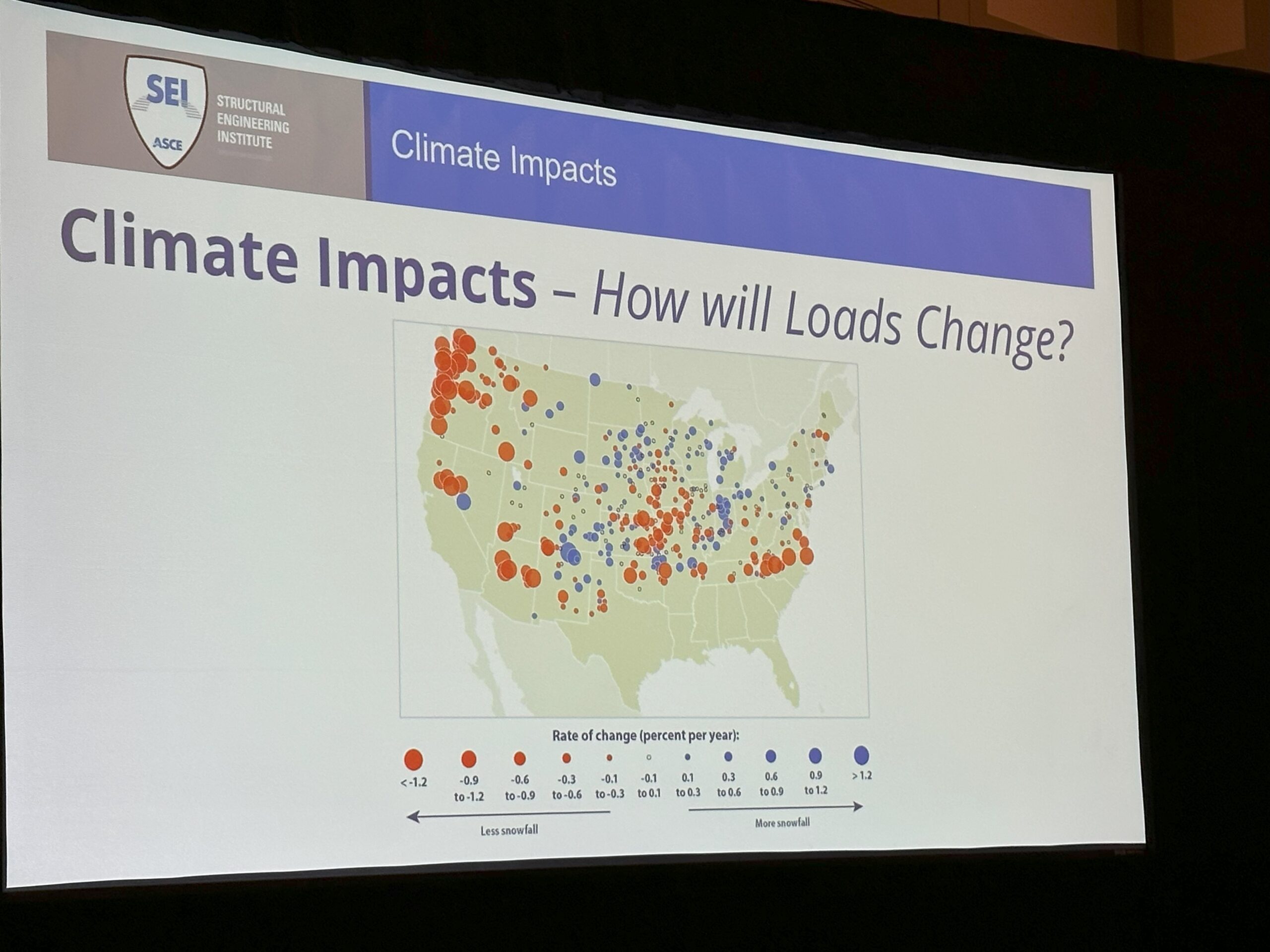
snow-loading-changes

Structures Congress 2023 Wrap-Up

The annual Structures Congress hosted by the Structural Engineering Institute (SEI) of the American Society of Civil Engineers (ASCE) took place this year in New Orleans, LA, from May 3 to May 6. This is the largest annual structural engineering conference in the United States and allows attendees to learn, engage, and network within the structural engineering community. The Congress serves as an opportunity to learn about the latest technical subjects and Code updates as well as the current and new initiatives being promoted by SEI to better the profession. The Congress is also where the numerous committees and subcommittees gather for face-to-face meetings the day before the Congress officially starts. It was great to engage with old and new colleagues on a full range of topics but in particular embodied carbon and how the structural engineering profession is responding.

To understand just how much focus is being paid to climate change and embodied carbon, one simply needs to evaluate the number of sessions on the subject. Here are a few statistics.

  1. Just under 25% of all technical sessions included mention of climate change in the topics of:
    • Embodied carbon
    • Resilience
    • Conceptual design
    • Code change
    • Thermal bridging
  2. Over 10% of all technical sessions were focused directly on climate change and embodied carbon.
  3. Two out of the three keynote presentations included specific commentary on carbon and the need to consider its measurement and reduction for future climate impacts.

Several of the sessions that discussed embodied carbon also highlighted SEI’s effort in this space by promoting the SE 2050 Commitment Program (https://se2050.org/) that SEI launched in November, 2020. Cora Structural’s Founder and Principal, Michael Gryniuk, who currently serves as Chair of SE 2050, facilitated the annual face-to-face committee meeting on Wednesday, May 3 which included the following items:

  • Update on current status of the Program since launch in November, 2022
    • 117 Signatory Firms
    • 500+ Projects in the SE 2050 Database
    • Over 1,100 newsletter sign ups
  • Reviewed the results of the strategic planning sessions from early 2023
  • Discussed that a key item for future planning is the coordination with the SEI Prestandard for Calculation Methodology for Structural Systems in Whole-Building Life Cycle Assessments currently being developed by the Sustainability Committee
  • Outlined the priority focus areas and deliverables over the next 18 months
  • A broader discussion and brainstorming for the future of SE 2050

As noted there were several technical sessions that highlighted the impacts of climate change on the structural engineering profession. Of particular note was a session on the upcoming 2028 version of ASCE/SEI 7 (Minimum Design Loads and Associated Criteria for Buildings and Other Structures). The session reviewed a new section to be included (non-mandatory) that would include ‘future conditions to account for load changes due to climate change’. The new section is in the early stages of development and the content is not yet set, however, it is understood that the loads would be based on design life and dependent on risk category among other items. As one might imagine, the topic fostered a healthy debate on when an owner might want to include such design considerations, how the level of design loads would be established, how such design future loading conditions might impact present costs, and a lengthy discussion on risk mitigation and liability. And to what extent the structural engineer should or shall be involved.

Cora Structural Joins SE 2050! 750 181 CORA Structural
sei_se2050_netzero_logo_color_medium

Cora Structural Joins SE 2050!

Cora Structural is pleased to announce that we have joined SE 2050! We join over 115 other like-minded firms who have made the commitment to address the climate emergency through our daily practice. We couldn’t be any more thrilled to contribute to this critically important Program within the Structural Engineering Institute (SEI) of the American Society of Civil Engineers (ASCE). The Program mission of “transforming the practice of structural engineering in a way that is holistic, firm-wide, project based, and data-driven” is in strong alignment with the mission of our firm to “provide exceptional structural engineering services while simultaneously contributing to the greater good”.

We have been part of SE 2050 from its inception with our Founder and Principal, Michael Gryniuk, serving as its first Chair starting in the Winter of 2019 following several years of work on it within the SEI Sustainability Committee and in collaboration with the Carbon Leadership Forum (CLF).

We believe, as structural engineers, that addressing the climate emergency should be central to our daily work through a renewed focus on minimizing structural material quantities, providing our clients with sufficient structural system options early on in the project that minimize whole carbon while maximizing functionality, educating our fellow team members on ways to measure and reduce embodied carbon, and being present during the procurement stage to ensure specified materials can be purchased. We believe that all structural engineers should be able to speak the language of embodied carbon in the way that works best for them.

We believe that all structural engineers should be able to speak the language of embodied carbon

Michael Gryniuk, Cora Structural Founder and Principal

As a first requirement to join the Program, Cora Structural wrote a commitment letter signed by Michael Gryniuk, which was submitted to SEI’s Managing Director, Laura Champion. Following the requirements of the Program, within six months Cora Structural will submit our first Embodied Carbon Action Plan (ECAP) which will outline our plan to educate, advocate, track and ultimate reduce embodied carbon on our projects through focused and upfront conversations with our clients and the project owners.

We feel strongly that proactive early conversations with clients and owners is the only viable way to ensure embodied carbon measurements and reduction solutions can be evaluated and implemented with little to no cost impact to the project.

Michael Gryniuk, Cora Structural Founder and Principal

Finally, the second major requirement of joining the Program is that we will submit project data, anonymized, to SE 2050’s centralized database for their tracking and for which they will ultimately use for establishing industry-wide benchmarks and trends of structural embodied carbon impacts.

We are eager to get to work!

Industry Collaboration on Embodied Carbon 1024 769 CORA Structural
img_0928

Industry Collaboration on Embodied Carbon

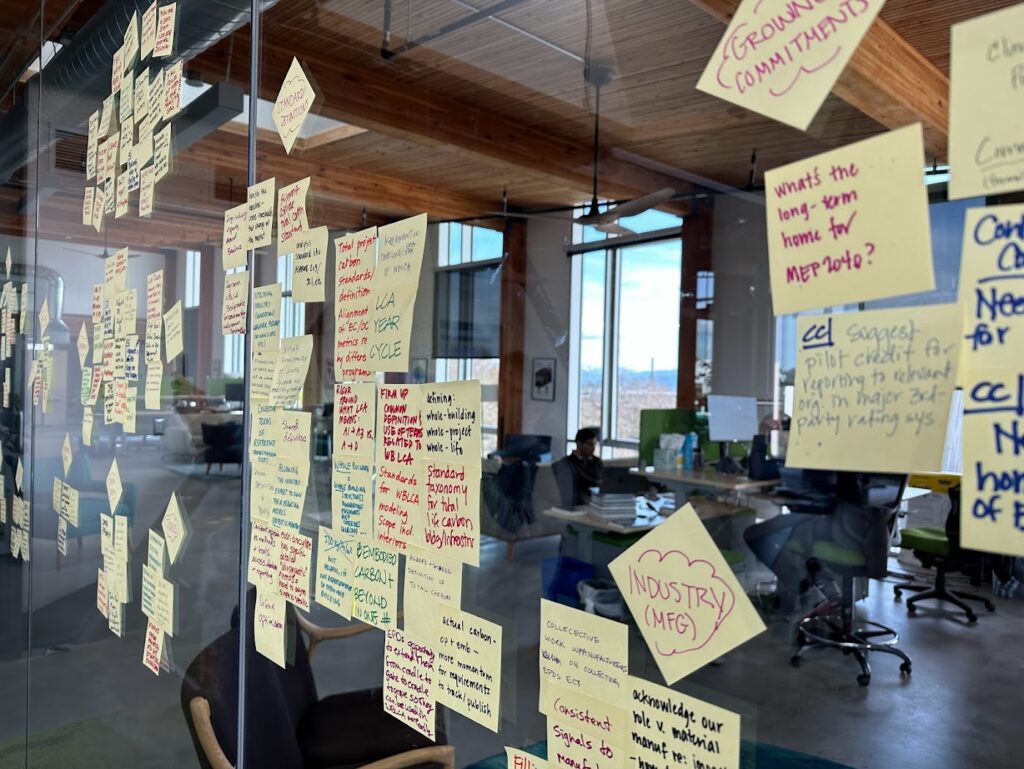
In his capacity as Chair of SE 2050, Cora Structural Founder and Principal, Michael Gryniuk, was very happy to take part in an initial meeting of industry leaders to discuss a potential coalition to accelerate and strategize how to rapidly reduce embodied carbon in the built environment. The group was composed of representatives from a set of NGOs and professional commitment groups who are engaged in gathering embodied carbon data from the built environment for professional carbon reduction commitment programs or certification systems, as well as other awareness and engagement activities.

The group explored working together to streamline embodied carbon data collection and reporting, align on key terminology, build awareness around solutions of the positive environmental attributes that building materials can achieve, and speak together with a harmonized voice to accelerate progress.

Following years of collaboration amongst various individual groups, built environment industry leaders came together for the first time at one table on March 14th, 2023 in Seattle, Washington, to discuss a potential coalition to accelerate and strategize how to rapidly reduce embodied carbon in the built environment.

The workshop was convened by Architecture 2030Building Transparency, Carbon Leadership Forum, International Living Future Institute, and the US Green Building Council. In attendance were members of the organizing groups along with representatives from:

Reducing embodied carbon is recognized as a key action area for the built environment industries — including design, real estate, and construction — to address climate change. The need to address carbon emissions in the built environment has been propelled by a groundswell of action across industries including the recent Buy Clean components of the Federal Inflation Reduction Act. Collaboration among industry leaders is seen as necessary to enable positive outcomes to those actions.

The group explored working together to streamline embodied carbon data collection and reporting, align on key terminology, build awareness around solutions that building materials can achieve, and speak together with a harmonized voice to accelerate progress. Together, this collaboration will accelerate the transition of the built environment towards positive environmental outcomes through design practices and material choices.

As organizations currently or imminently gathering embodied carbon data from the built environment industry, creating tools and resources, and building awareness about this critical issue, we believe that we can move faster together. We will be meeting again in May to plan our collaboration.

HSS Fabrication Plant Visit 1024 768 CORA Structural
HSS Fabrication

HSS Fabrication Plant Visit

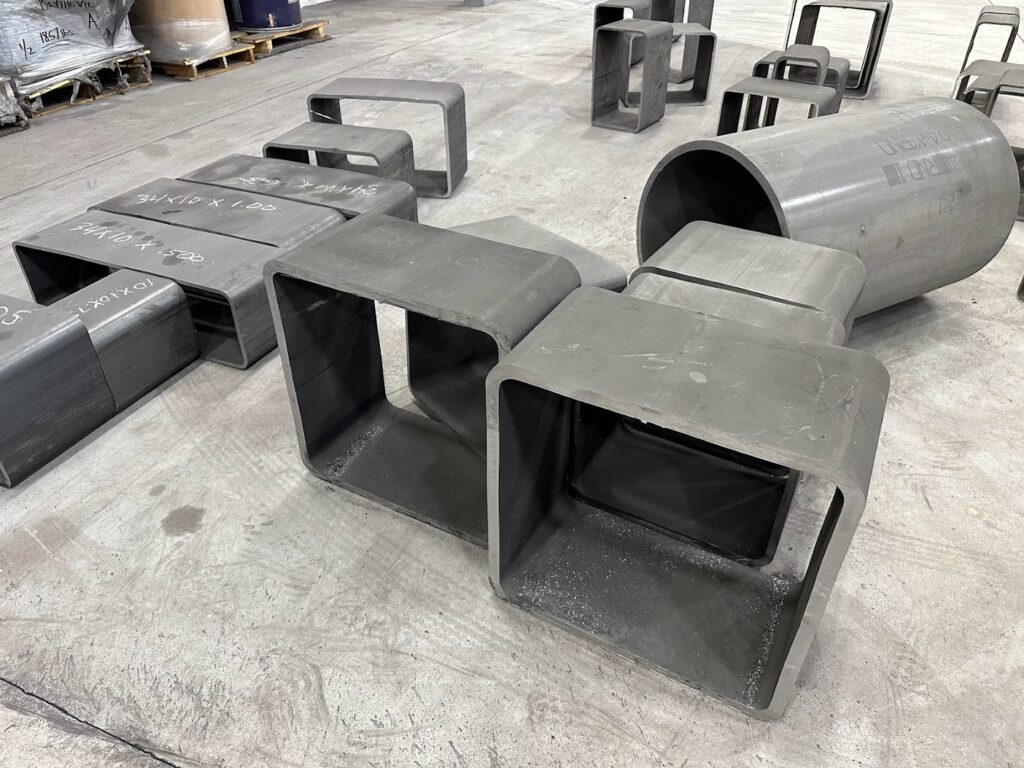
Cora Structural had the opportunity to visit the massive Atlas Tube facility in Blytheville, AR to see first hand how Hollow Structural Sections (officially HSS but you probably know them as ‘tubes’) are made.  Starting with the initial unbuckling of the huge steel coils, continuing on to the splicing of plate ends and the slowly folding to round sections and eventual rectangular sections, to the continuous seam welds, and finally to the finish cutting and stacking, it was an incredible process to witness!  And each step of the way is covered by critically important quality control measures and a highly trained staff. 

DID YOU KNOW? All square and rectangular sections start as round sections, which are then methodically shaped into sections with flat edges by way of a series of rollers while simultaneously being doused with water to keep things cool and moving smoothly.

In our humble opinion, being in facilities producing the structural elements we design and specify daily provides an invaluable perspective that ultimately makes us better structural engineers.  We are so thankful to Atlas Tube for the opportunity and for taking the time to show us around and answer all of our (many, many) questions.